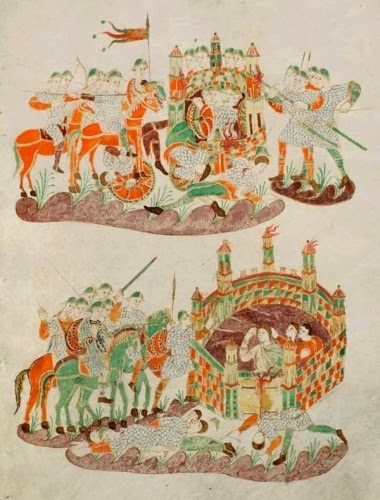
Thursday, 8 January 2015

List of known campaigns and battles

Here follows a list of known engagements held during the reign of the last three Carolingian rulers of East Francia. Descriptions of the battles do not give numbers, tactics or deployments and at best name only the principle leaders. We do know armies were not very large as logistical methods could not sustain armies in the field for long periods. 
   
I have a series of scenarios based on a number of historical events listed below and using DBA 3.0, many of these will be fought between unequal sized forces over unusual terrain setups making them unique. These will follow soon.

Louis the German,
825 Louis II campaigns against the Wends and Sorbs.
832 (2nd Civil War) Louis leads an army of Slavs to invade Alemannia. Louis the Pious disinherits Louis but is captured and deposed by his sons.
839 (3rd Civil War) Louis again invades Alemannia. By force of arms, peace was resolved between father and son.
840 Louis the Pious dies.
854 Louis invades Aquitaine to seize the crown from Charles the Bald, but turned back at Limoges.
858 Louis the Younger campaigned against the Abodrites to the east and again in 862.
863 Charles and brother Carloman revolt against their father Louis II.
876 Louis on the 8th October defeated Charles’ much larger host of West Francia at Andernach.
876 Louis II sent Charles and then Carloman with armies containing Italian forces under Berengar of Friuli, their cousin, to possess the Italian kingdom.

Louis the Younger,
880 Charles joined Louis III and Carloman, joint kings of West Francia, in besieging Boso of Provence in Vienne from August to September but they failed to dislodge him.
880 Louis confronted and defeated a Norse host at the Battle of Thimeon
880 Saxon army, led by Duke Bruno, brother-in-law to the king, was defeated at Hamburg.
880 Resettlement of the Great Danish Army to the Low Countries.

Charles the Fat
882 to 884, the Wilhelminer War in Marcha Orientalis (later Austria).
882 Charles campaigned against the Danes to reunite the whole of East Frankish realm. Besieged at Asselt, the Viking chiefs Godrey and Sigfred accepted Christianity and became vassals of Charles.
885 Siege of Paris.
887 General rebellion by Arnulf led his Bavarians and Slav allies against Charles.
888 Death of Charles, last Carolingian ruler of East Francia. 

This list is by no means complete, but will be revised as I encounter more information.  

Cheers,

Saturday, 3 January 2015

The DBA Carolingian army list

DBA 3.0 army list the (III/28) Carolingian army as the following: 
AD 639 to 888.

1 x General (3Kn),
2 x caballarii (3Kn),
2 x Swabian or Bavarian milites (3Kn//4Bd) or  Gascon javelinmen (2Ps) + Gascon light horse (2LH),
1 x caballarii (3Kn) or if Thuringian (3Cv)
4 x levies (all 4Sp),
1 x archers (3Bw or 2Ps),
1 x archers (2Ps) or levies (7Hd).


Simulating the early military period of Louis the German (AD 840 – 876) the above can use some minor modification for simulating historical scenarios.

Gascon troops
Firstly, I have not found any references to Gascon or Basque troops serving with the Eastern Empire. Light troops were certainly supplied by various Slav allies and there are even references of Magyar light horse serving as mercenaries, not unlike the early Huns serving as mercenaries ahead of Attila's campaigns. So optional troop types remain, but are of a different nationality.

Swabian/Bavarian milites
Louis began his regal career as Duke of Bavaria (817). Reflecting on the animosity between brothers I would be unsure about Bavarian milites serving among West Frankish armies after this period. Taking this a further step, would Louis’ initial command consist solely of Bavarian milites, levy and archers?  

Verbruggen does make reference to the Bavarian knights dismounting to fight but mentions in the next sentence they were ready to mount and pursue a fleeing foe. Further, under the section on tactics, a good commander held mounted troops as part of his reserve and stationed himself with them.

Levy spearmen
In 840, Louis became ruler of East Francia and with it came the military resources of the empire. We do know the East Franks followed the practices set down by Carolingian capitulary law regarding equipment, terms of service, etc. From my reading so far, the milites were prepared to campaign outside their duchies. This is better documented during reign of Henry the Fowler.


Designing scenarios
We can imagine lesser nobles raising their levies to deal with local incursions. If the situation required the milites, these would be assembled to be led by their ruling noble or bishop. This process becomes a bit more complex when we consider the family rivalries affecting the recruitment of armed troops, but that makes this fun.

More on this later.

Thursday, 1 January 2015

Common terms of the period.


I think the reader may find the following description of commonly used terms of the period. Descriptions were complied from various Wiki sources. 

*The stem duchies (German: Stammesherzogtümer, from Stamm, literally "tribe") were essentially the domains of the old Germanic tribes of the area associated with the Francia, especially the Eastern part upon the 843 partition by the Treaty of Verdun, in the Early Middle Ages.

The tribes that became stem duchies were originally the Alemanni, the Thuringii, the Saxons, the Franks, the Burgundians, and the Rugii. The tribes were part of the Völkerwanderung (or Germanic migrations) of the 5th century. In 443 and 458, the Burgundians moved to settle in the Kingdom of Burgundy; the area they had formerly occupied in Germania was then occupied by the Franks. The Franks were a fusion of West Germanic tribes whose leaders had long been aligned with Rome. The Rugii were destroyed in the wars over Italy in the 5th and 6th centuries, and a new confederation of Germanic peoples formed in their place: the Bavarii. All these tribes in Germania were eventually subjugated by the Franks; the Alemanni fell in 496 and 505, the Thuringii in 531, the Bavarians at some point after 553, and then finally the Saxons by 804 in a protracted campaign by Charlemagne himself.


**Marches  North and south of Bohemia, the Germans headed east, founding a series of border counties or Marches, ruled by margraves (mark-graf). To the north these started with the Margraviate of Meissen and the March of Lusatia, and to their north the Northern March, which became later the Margraviate of Brandenburg (the heart of the later Kingdom of Prussia). Last in the north was originally the Billung March, which eventually became the duchies of Holstein, Lauenburg, Mecklenburg, and Hither Pomerania. In the south, there were the marches of Carniola, Carinthia, Styria, and Austria (later Österreich ("eastern realm") or Duchy of Austria). 

***Herzog Herzog is not related to Herz ('heart'), but derives from German(ic) He(e)r ('army') and zog (ziehen) (English: 'to pull, drag', also in die Schlacht ziehen "to go into battle"), a military leader. Thus Herzog was a title borne by Germanic warriors who exercised military authority over a tribe by general acclaim among its members or warriors, especially in the stem duchies. During the medieval era, some of the most powerful vassals whose territories lay within the boundaries of the Holy Roman Empire took or were granted the title of Herzog by the Emperor. Several dynasties, such as the Habsburgs of Austria, Hohenzollerns of Prussia, Welfs of Hanover, Wettins of Saxony, Wittelsbachs of Bavaria and the House of Württemberg, held the Herzogswürde (dukedom) before becoming kings.


****Ministeriales Ministerialis; a post-classical Latin word, meaning originally servitor, agent, in a broad range of senses. These were people raised up from serfdom to be placed in positions of power and responsibility. Ministeriale(n) and Dienstmann, came to describe those unfree nobles who made up a large majority of what could be described as the German knighthood during that time. What began as an irregular arrangement of workers with a wide variety of duties and restrictions rose in status and wealth to become the power brokers of an empire. The ministeriales were not legally free people, but held social rank. Legally, their liege lord determined who they could or could not marry, and they were not able to transfer their lords' properties to heirs or spouses. They were, however, considered members of the nobility since that was a social designation, not a legal one. Ministeriales were trained knights, held military responsibilities and surrounded themselves with the trappings of knighthood, and so were accepted as noblemen. Both women and men held the ministerial status, and the laws on ministeriales made no distinction between the sexes in how they were treated.

Abbot Adalard of Corbie (d. 826) was Emperor Charlemagne's chief adviser, and described the running of the government in his work De ordine palatii. There he praises the great merits of his imperial staff, made up of household servii proprii (serfs) who were the first ministerials authoritatively recorded. 

It was Emperor Conrad II (990-1039) who first referred to ministerials as a distinct class. He had them organized into a staff of officials and administrators. In documents they are referred to as ministerialis vir, or ministerial men.

Ministeriales as household servants were entrusted with special responsibilities by their overlords, such as the management of a farm, administration of finances (chancery) or of various possessions. 

Kings placed military requirements upon their princes, who in turn, placed requirements upon their vassals. The free nobles under a prince may have a bond of vassalage that let them get out of serving, so kings, princes, bishops and archbishops were able to recruit unfree persons into military service. 

There were two sorts of ministerials: casati, who administered lands and estates for a liege and were paid from the proceeds of the land and non-casati, who held administrative and military positions but were paid in either a fixed amount of coin or by a portion of the proceeds of mills, road or bridge tolls, or ferry fees or port taxes.

One constant is that all arrangements included a duty owed to the lord for military service. This could take the form of actual personal service by the ministeriales or a payment to fund others who went to war. The monastery of Maurmunster records the following:

When a campaign (profectio) of the king is announced to the bishop (of Metz, in this case) the bishop will send an official to the abbot, and the abbot will assemble his ministeriales. He will inform them of the campaign, and they will assemble the following men and equipment...: one wagon with six cows and six men; one packhorse with saddle and equipment and two men, the leader and the driver...If the king moves the army to Italy, all the peasant farms shall contribute for that purpose their usual taxes (that is, probably an entire annual rent as an extraordinary tax). But if the army moves against Saxony, Flanders or elsewhere on this side of the Alps, only half that amount will be given. From these additional taxes the wagons and pack animals will be loaded with rations and other items necessary for the journey.

In Bamberg the Carolingian method of providing for a campaign remained in effect. Ministeriales were grouped into threes; one went on campaign while the other two were responsible for equipping and victualing him. This ensured that those who were sent to war were prepared for war. this also shows that a military obligation didn't necessarily mean riding off with the army. 

*****Heerbann The Heerbann (also formerly Heermannie, Mid. Latin: Heribannus, French: Arrière-ban), in the Imperial Military Constitution (Reichsheeresverfassung) of the Holy Roman Empire, was the call to all free landowners capable of bearing arms to participate in a military campaign, i.e. in an imperial war (Reichskreig).

However, as the feudal system in the Holy Roman Empire developed in the Early Middle Ages, the Heerbann became superfluous as a means of raising armies and increasingly fell into disuse after the death of Charlemagne.

The Heerbann was particularly imposing for poorer landowners, several of whom had to equip a knight for war (one for every 3 hides), so they would attempt to withdraw themselves from his service and place themselves in the service of and under the protection of a more powerful lord, who would assist them in providing the necessary military equipment or even stand them down from military service entirely.

Towards the end of the 10th century, this led to the reshaping of the entire military constitution. The armies of the king now no longer consisted of all free knights, but came from powerful imperial officials or vassals and their entourages; and those who rendered no military service had to pay a campaign tax (Heersteuer).

The necessary organisation of the Heerbann, needed thanks to constant campaigning by Charlemagne, was divided by him into seven levels or "shields of knighthood", the so-called Heerschilde. The campaigns, which were fought with the aid of the Heerbann, were called Heerfahrten, the participation of the vassals was known as Heeresfolge.

By the time of the Crusades, when the feudal system had reached its height, the Heerbann had almost totally disappeared in all European states.


******Heerschild The Heerschild (Latin: clipeus militaris), also called the shield of knighthood, in the Early Middle Ages was the right to raise a feudal levy of troops. The call to do so was the Heerbann. The resulting importance of a system of military ranks, based on the ability to provide men for a campaign, became modified in the law books published in the 13th century. It finally ended up as being an important part of the structure of medieval society, as captured in the feudal law element of the Sachsenspiegel by Eike von Repgow.

The Sachsenspiegel, the Saxon law book, portrays the society of the medieval empire as divided into seven feudal military levels or Heerschilde (lit.: "army shields"). This Heerschildordnung was a scale determining a nobleman's status and was not based on military criteria. The first Heerschild was the king or emperor as the supreme overlord. This was followed by the second "shield", formed by the ecclesiastical princes - the bishops and abbots - of the empire. The third level comprised the secular or lay princes, who, in turn, sat above the "free lords" (freie Herren), i.e. nobles who were not princes, of the fourth stratum. The fifth and sixth Heerschilde were formed by freeman, whether eligible for jury service (schöffenbar) or not, in other words commoners who were able to act as magistrates (5th level) or not (6th level). As to the seventh level, the Sachsenspiegel remains vague, both in terms its composition, as well as whether it was in any real sense a Heerschild. Based on this division of society, the Sachsenspiegel then dealt with the feudal law rights and obligations of each Heerschild.


Monday, 29 December 2014

East Francia under Charles the Fat

Charles III, the Fat was the youngest son of Louis the German and ruled as Emperor from 881 to 888. He was the last Carolingian to rule over a united empire. The re-unification however, would not last. During a coup led by Arnulf of Carinthia in November 887, Charles was deposed in East Francia, Lotharingia, and Italy. The Empire quickly fell apart after his death, never to be restored, with the Empire splintering into five separate successor kingdoms.


Youth
Charles was the youngest of the three sons of Louis the German, first King of East Francia, and Emma, a Welf. In AD 859, Charles as Count of the Breisgau, became involved with his brothers in a series of revolts. In 863, his eldest brother Carloman revolted against their father, followed by Louis the Younger the next year. Charles joined Louis. In 865, the elder Louis was forced to divide his lands among his heirs: Bavaria went to Carloman; Saxony (with Franconia and Thuringia) went to Louis; and Alemannia (Swabia with Rhaetia) went to Charles. Lotharingia was to be divided between the younger two.

In 876, Louis the German died and the inheritance went as planned after a conference at Ries, though Charles received less of his share of Lotharingia than planned. In his charters, Charles' reign in Germania is dated from his inheritance in 876.

In 880, Charles joined Louis III and Carloman, joint kings of West Francia, in besieging Boso of Provence in Vienne from August to September but they failed to dislodge him. In August 882, Charles sent Richard the Justiciar, Count of Autun, to take the city, which he did (in September). After this, Boso could not regain most of his realm and was restricted to the vicinity of Vienne.

Coronation and Italy
Crowned Emperor on 12 February 881 there were hopes of a general revival in western Europe, but Charles  proved unequal to the task.

In February 882, Charles convened a diet in Ravenna with a goal to have Duke Guy of Spoleto restore stolen papal lands. In a letter to Charles, Pope John claimed that the vows went unfulfilled. In 883 Duke Guy, accused of treason made an alliance with the Saracens. Charles sent Berengar, equipped with an army, to seize Spoleto. Berengar, initially successful was forced to retire as an epidemic of disease struck all Italy.

East Francia
Defeated by Alfred the Great at the Battle of Ethandun in 878, the Great Heathen Army settled in the Low Countries. Louis III, Charles' brother, opposed them with some success, but he died after a brief campaign on 20 January 882. Charles succeeded to his kingdom and reunited the whole East Frankish realm again.

When he had returned from Italy, Charles held an assembly at Worms with the purpose of dealing with the Vikings. The army of the whole of East Francia was assembled in the summer under Arnulf, Duke of Carinthia, and Henry, Count of Saxony. The chief Viking camp at Asselt was besieged and not long after Charles opened negotiations with them. The Viking chiefs, Godfrey and Sigfred, Godfrey accepted Christian baptism and Sigfred was bribed off. 

From 882 to 884, the Wilhelminer War dominated the Marcha Orientalis (later Austria). Arnulf of Carinthia, Charles's illegitimate nephew, allied with the rebel Engelschalk II against Charles' appointed margrave in the region, Aribo. Svatopluk I, ruler of Great Moravia, took up Aribo's cause and, in 884 at Kaumberg, took an oath of fidelity to Charles. Though the emperor lost his vassals of the Wilhelminer family and his relationship with his nephew was broken, he gained powerful allies in the Moravian dux and other Slavic duces in the area.

In 885, fearing Godfrey and his brother-in-law, Hugh, Duke of Alsace, Charles arranged for a conference at Spijk near Lobith, where the Viking leader fell into his trap. Godfrey was executed and Hugh was blinded and sent to Prüm.

Succession matters
Charles, childless by his marriage to Richgard, tried to have his illegitimate son by an unknown concubine, Bernard, recognised as his heir in 885, but met the opposition of several bishops. After the failure of his first attempt, Charles set about to try again. Charles met the new Pope Stephen V and probably negotiated for the recognition of his son as his heir. A planned assembly with the goal to confirm Charles ‘illegitimate son as heir had come to naught as the pope refused to attend.

Matters came to a head in late 887. Family issues divided the household and his inner circle then began to fall apart. On 11 November, he called an assembly to Frankfurt. While there he received news that an ambitious nephew, Arnulf of Carinthia, had initiated a general rebellion and was marching into Germany with an army of Bavarians and Slavs. The following week his support in East Francia collapsed with the Alemanni being the last to leave him. By 17 November, Charles was out of power. Moving to Naudingen he died there six weeks later, on 13 January 888.

The spoils
The Empire fell apart, never to be restored. Arnulf desired the whole empire, but held East Francia and Lotharingia. Italy shuffled between three different claimants; Odo, Guy III of Spoleto, and Berengar. Louis was crowned in Provence, Burgundy went to Rudolph and in Aquitaine, Ranulf II declared himself king and took the guardianship of the young Charles the Simple, the Carolingian heir to the West.


Next post
We take a look at the DBA III/28 Carolingian army list and how this can best be used to campaign the dynastic rivalries and regional rebellions. 

Sunday, 28 December 2014

East Francia under Louis III, the Younger

Louis the Younger (830/835 – 20 January 882), crowned Louis III] was the second eldest of the three sons of Louis II the German. He succeeded his father as the King of Saxony on 28 August 876 and his elder brother Carloman as King of Bavaria from 880 to 882. He died in 882 and was succeeded by his younger brother, Charles the Fat, already King of Italy and Emperor.


Louis III, the Younger (r.)

Military youth
As a young man, Louis was deployed in military operations against the Abodrites to the east in 858 and 862. In 854, at the invitation of the nobles of Aquitaine opposed to Charles the Bald and Pepin II, and coaxed by his father and his cousin Charles, Archbishop of Mainz, he crossed into Gaul at the head of an army, intent on receiving the crown of Aquitaine. He marched as far as Limoges before turning back.

At home, Louis forged close ties with the nobles of the East Francia and became increasingly independent from his father. In 865, he and his brother Charles joined in rebellion against their father. The "revolt" was brief, however, and Louis, Charles, and their father were reconciled later that year. The division of territories was now made definite as Louis received Saxony, Thuringia, and Franconia and Charles Alemannia and Rhaetia.

In 869, Louis married Luitgard, daughter of Liudolf, Duke of Eastphalia, at Aschaffenburg. Luitgard was a strong-willed and politically ambitious woman and later on spurred her husband to pursue ambitious goals. This match increased dissension between father and son and in 871 and in 873, Louis rebelled, but each time he was reconciled.

Rule in Saxony
Upon his father's death in 876, Louis fully inherited the title Rex Francorum ("king of the Franks"). Louis the Younger considered himself the true heir of Louis the German and as his father died in 876, Louis buried him in the abbey of Lorsch, in his own territories, in order to emphasise his primacy to his brothers. Louis also retained his father's chief advisor, Luitbert, Archbishop of Mainz. He and his brother ruled their kingdoms independently but cooperatively.

Acquisition of Lotharingia and Bavaria
Louis's rule was immediately threatened by Charles the Bald, who tried to annex the eastern parts of Lotharingia and attempted to achieve supremacy over his nephew. Louis brought war on Charles and, on 8 October 876 at Andernach, he defeated the much larger host of West Francia. The East Frankish army displayed superiority in both unity and tactics, his soldiers dressed in white garments appeared as an army of dead spirits.

After this victory, Louis the German's three sons met in November at Nördlingen to discuss the division of their father's kingdom and to have their hosts swear allegiance. According to the plan drawn up in 865, Carloman received Bavaria, Charles Swabia, and Louis Saxony, Franconia, and Thuringia. Throughout his reign, though Louis is always called "King of Saxony" by historians, he never visited Saxony proper, though it formed the bulk of his territory. At the end of 877, the brothers assembled again to discuss the administration of their half of Lotharingia.

Following the death of Charles the Bald in November 878, his successor, Louis the Stammerer promised to respect the agreements made in 865 and 877. Known as the Treaty of Fouron, this was soon put to the test, when Louis the Stammerer died in April 879. A party of nobles and church dignitaries invited Louis the Younger to succeed to the rule of the western kingdom. Marching toward Verdun, the new kings Louis III and Carloman offered their part of Lotharingia to Louis. He retreated and in February 880, his gains were confirmed by the Treaty of Ribemont. This treaty determined the border of the two kingdoms that were to remain unchanged until the fourteenth century.

Viking incursions
Since the summer of 879, Vikings had been increasing their attacks on the Frankish kingdom and occasionally penetrated deeply into the interior of the land. Louis's kingdom was the most hard-hit after that of West Francia. In February 880, Louis confronted and defeated a Norse host at the Battle of Thimeon (near modern Charleroi) and drove the Norse out of Nijmegen. Despite these victories, a Saxon host commanded by Duke Bruno, suffered a heavy defeat near Hamburg. As Thimeon illustrates, no single military victory could stop the tide of Viking incursions.

Death and succession
Louis fell sick in 881 and died in Frankfurt on 20 January 882. He was buried beside his father in the abbey of Lorsch. Since he left no heir, all his territories fell to his brother Charles, who thus could reunite the entire East Frankish kingdom. 

Source: Wiki.

Friday, 26 December 2014

East Francia under Louis II “the German”

Louis was a grandson of Charlemagne and the third son of the succeeding Frankish Emperor Louis the Pious  was made the King of Bavaria from 817 following the Emperor Charlemagne's practice of giving a local kingdom to a family member who then served as the local governor. The division of the empire by Louis I in 840 meant Louis II would be made King of East Francia. East Francia at this time has been covered in three earlier postings. Here, I will highlight his struggle to hold the kingdom together until his death in 876.


Civil war, 840–843
When Louis I died in 840, Lothair claimed the whole Empire prompting Louis II to ally himself with the half-brother, Charles the Bald. At the Battle of Fontenay in June 841, Louis II and Charles were able to defeat Lothair. In June the following year, the three brothers met negotiate a peace, and arrange the boundaries of their respective kingdoms. The resolution, known as the Treaty of Verdun, confirmed Louis II holdings east of the Rhine (Eastern Francia), together with a district around Speyer, Worms, and Mainz, on the left bank of the river. His territories included Bavaria (where he made Regensburg the centre of his government), Thuringia, Franconia, and Saxony, hence the appellation of “the German”.

Having in 842 crushed the Stellinga rising in Saxony, in 844 he brought the Obotrites to heel by putting their prince, Gozzmovil, to death. Thachulf, Duke of Thuringia, then undertook campaigns against the Bohemians, Moravians, and other tribes, but was less successful against the Vikings.

Conflict with West Francia
Following unrest in Aquitaine, Louis II sent his son, Louis the Younger to secure the throne as the people of Aquitaine had enough of the misrule of Charles the Bald. After a number of futile attempts, Louis II supported by his nephews Pepin II and Charles, King of Provence, invaded Aquitaine in 858. Charles the Bald could not even raise an army (treachery and desertion) to resist the invasion and fled to Burgundy.

In 855, the emperor Lothair died, and Louis and Charles for a time seem to have cooperated in plans to divide Lothair's possessions among themselves — the only impediments to this being Lothair's sons: Lothair II (who received Lotharingia), Louis II (who held the imperial title and the Iron Crown), and the aforementioned Charles. In 868, at Metz they agreed definitely to a partition of Lotharingia; but when Lothair II died in 869, Louis the German was lying seriously ill, and his armies were engaged with the Moravians. Charles the Bald accordingly seized the whole kingdom; but Louis the German, having recovered, compelled him by a threat of war to agree to the Treaty of Meerssen, which divided it between the claimants.

Heir to the throne?
The later years of Louis the German were troubled by risings on the part of his sons, the eldest of whom, Carloman, revolted in 861 and again two years later; an example that was followed by the second son Louis, who in a further rising was joined by his brother Charles. In 864, Louis was forced to grant Carloman the kingdom of Bavaria, which he himself had once held under his father. The next year (865), he divided the remainder of his lands: Saxony he gave to Louis the Younger (with Franconia and Thuringia) and Swabia (with Raetia) to Charles, called the Fat. After taking Bari from the Saracens in 871, Louis was held hostage by Sergius of Naples, Waifar of Salerno, Lambert of Spoleto and Adelchis of Benevento. He was later released after swearing never to return to southern Italy. A report that the emperor Louis II (of Italy) was dead led to peace between father and sons and attempts by Louis the German to gain the imperial crown for Carloman. These efforts were thwarted by Louis II, who was not in fact dead, and Louis' old adversary, Charles the Bald.

Louis was preparing for war when he died on 28 August 876 at Frankfurt. He was buried at the abbey of Lorsch, leaving three sons and three daughters. His sons, unusually for the times, respected the division made a decade earlier and each contented himself with his own kingdom. Louis is considered by many to be the most competent of the grandsons of Charlemagne. He obtained for his kingdom a certain degree of security in face of the attacks of Norsemen, Magyars, Slavs, and others. He lived in close alliance with the Church, to which he was very generous, and entered eagerly into schemes for the conversion of his heathen neighbours.


Tuesday, 23 December 2014

East Frankish Empire

The Northern Region

The Duchy of Saxony (Low German: Hartogdom Sassen, German: Herzogtum Sachsen) originally was the settlement area of the Saxons in the late Early Middle Ages, when they were subdued by Charlemagne during the Saxon Wars from 772 and incorporated into the Carolingian Empire (Francia) by 804. Upon the 843 Treaty of Verdun, Saxony was one of the five German stem duchies of East Francia.

According to the Res Gestae Saxonicae by 10th century chronicler Widukind of Corvey, the Saxons had arrived from Britannia at the coast of Land Hadeln in the Elbe-Weser Triangle, called by the Merovingian rulers of Francia to support the conquest of Thuringian kingdom. More probably, Saxon tribes from Land Hadeln under the leadership of legendary Hengist and Horsa in the late days of the Roman Empire had invaded Britannia. (see Anglo-Saxon settlement of Britain).

The Royal Frankish Annals mention a 743 Frankish campaign led by the Carolingian Mayor of the Palace Carloman against the Saxons, followed by a second expedition together with his brother Pepin the Short the next year. In 747 their rebellious brother Grifo allied with Saxon tribes and temporarily conquered the stem duchy of Bavaria. Pepin, Frankish king from 750, again invaded Saxony and subdued several Westphalian tribes until 758.

In 772 Pepin's son Charlemagne started the final conquest of the Saxon lands. Though his ongoing campaigns were successful, he had to deal with the fragmentation of the Saxon territories in Westphalian, Eastphalian and Angrian tribes, demanding the conclusion of specific peace agreements with single tribes, which soon were to be broken by other clans. The Saxons devastated the Frankish stronghold at Eresburg; their leader (Herzog) Widukind refused to appear at the 777 Imperial Diet at Paderborn, retired to Nordalbingia and afterwards led several uprisings against the occupants, avenged by Charlemagne at the (alleged) Massacre of Verden in 782. Widukind finally had to pledge allegiance in 785, having himself baptised and becoming a Frankish count. Saxon uprisings continued until 804, when the whole stem duchy had been incorporated into the Carolingian Empire.

Afterwards, Saxony was ruled by Carolingian officials, e.g. Wala of Corbie (d. 836), a grandson of Charles Martel and cousin of the emperor, who in 811 fixed the Treaty of Heiligen with King Hemming of Denmark, defining the northern border of the Empire along the Eider River. Among the installed dukes were already nobles of Saxon descent, like Wala's successor Count Ekbert,  a close relative of Charlemagne.


Younger stem duchy
Subdued only a few decades earlier, the Saxons rose to one of the leading tribes in East Francia. Liudolf's elder son Bruno (Brun), progenitor of the Brunswick cadet branch of the Brunonen, was killed in a battle with invading Vikings under Godfrid in 880. He was succeeded by his younger brother Otto the Illustrious (d. 912), mentioned as dux in the contemporary annals of Hersfeld Abbey, which however seems to have been denied by the Frankish rulers. Otto's position was further secured through marriage to Hedwiga of Babenberg, daughter of mighty Duke Henry of Franconia, princeps militiae of King Charles the Fat. As all of Hedwiga's brothers were killed in the Franconian Babenberg feud with the rivalling Conradines, Otto was able to evolve the united Saxon duchy under his rule.

In 911 the East Frankish Carolingian dynasty became extinct with the death of King Louis the Child, whereafter the dukes of Saxony, Swabia and Bavaria met at Forchheim to elect the Conradine duke Conrad I of Franconia king. One year later, Otto's son Henry the Fowler succeeded his father as Duke of Saxony. According to the medieval chronicler Widukind of Corvey, King Conrad designated Henry his heir, thereby denying the succession of his own brother Eberhard of Franconia. 

Kingdom of Frisia
In the 7th and 8th centuries, Frankish chronologies mention the northern Low Countries as the kingdom of the Frisians. This kingdom comprised of the coastal provinces of the Netherlands, from the Scheldt to the Weser and the German North Sea coast and further east. Known as Greater Frisia, the inhabitants spoke a common language.

The 7th-century Frisian realm (650-734) under the kings Aldegisel and Redbad, had its centre of power in the city of Utrecht. Its ancient customary law was drawn up as the Lex Frisionum in the eighth century. Its end came in 734 at the Battle of the Boarn, when the Frisians were defeated by the Franks, who then conquered the western part up to the Lauwers. They conquered the area east of the Lauwers in 785, when Charlemagne defeated Widukind. The Carolingians laid Frisia under the rule of grewan, a title that has been loosely related to count in its early sense of "governor" rather than "feudal overlord".

This Frisia Magna was partly occupied by Vikings in the 840s, until they were expelled between 885 and 920. I am of the opinion the Vikings did not conquer Frisia, but settled in certain parts (such as the island of Wieringen). From these locations they continued their trade with the native Frisians. 


(Compiled from various Wiki sources)

Links Sources:
Southern Region

Central Region

Northern Region