Thursday, 13 April 2023

Sarmatians

These are Blue Moon figures and were purchased along with the Batavian to fill the role as allies for the Dacian army in the collection. These differ from the Old Glory Sarmatians, upper torso is cast with the kontos. This permits some variation when fixing the upper torso to the rest of the model. The bow case is separate but easy to assemble to the model.

The Blue Moon ancient line remains limited but figures do mix well with other manufacturers.


Thursday, 30 March 2023

The Batavian

With the goal to expand my latest project, the Early Imperial Roman, I ordered more German figures from Blue Moon Miniatures. The order would fill two commands, one standard Batavian army and a second for the revolt of AD 69/70. Anthony Riches’ trilogy, Betrayal, Onslaught and Retribution added an extra stimulus to compete this portion of the project as quickly as possible. 

Based for the most part in loose formation (3Wb), the standard Batavi have a complement of ‘heroes’ armed with long thrusting spear (4Wb). Assisting the Batavi are Suevi allies and their Sarmatian cavalry (3Kn) that certainly would bring an extra punch to any of their battles. The second command have no such allies, but do have Roman deserters (4Ax) bringing a contrast of armour and shield patterns.

Standard Batavi


Batavi of the revolt


Both in battle array


Tuesday, 28 March 2023

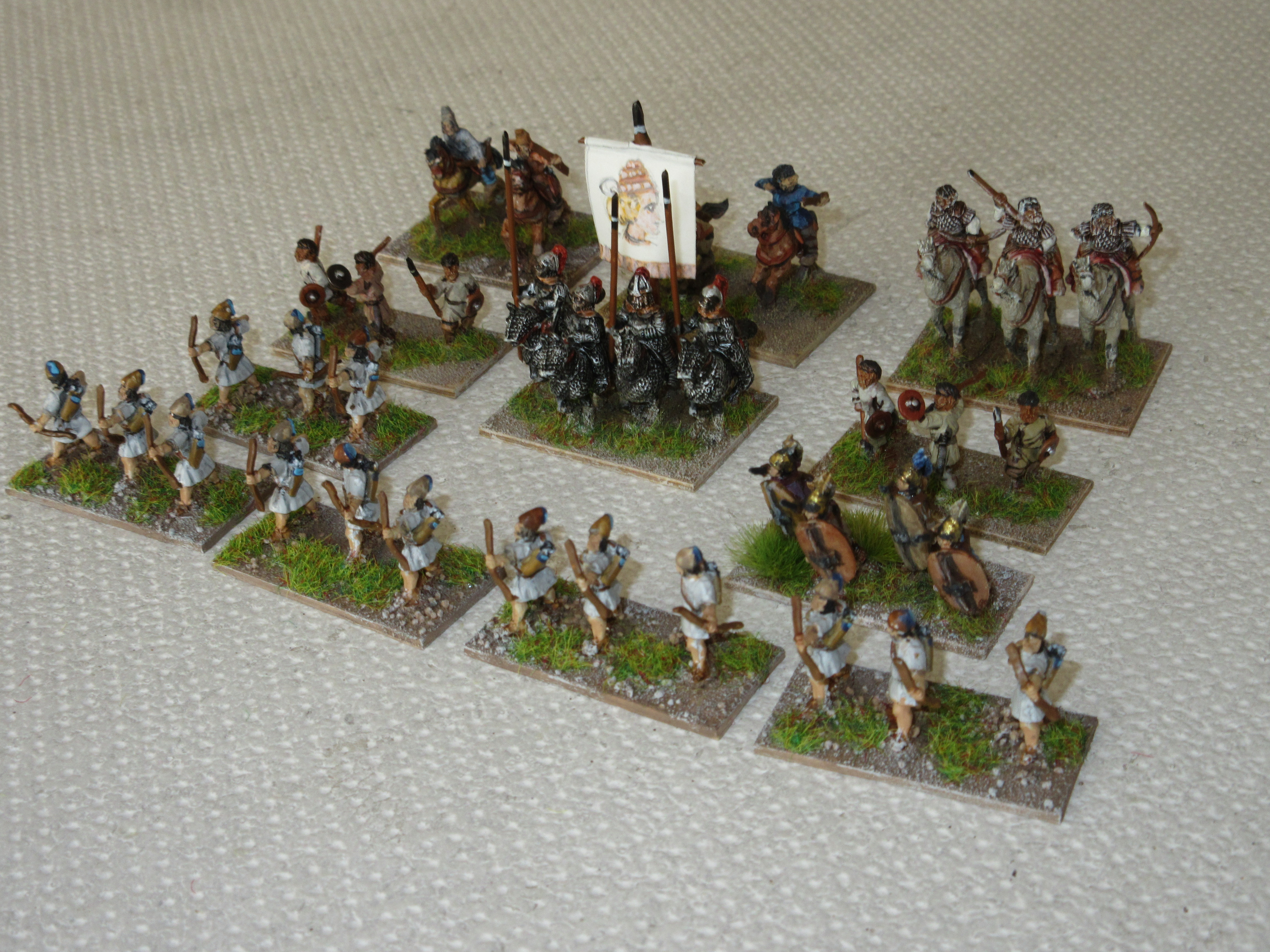
Client State of Emesa

Emesa became autonomous following the decline of the Seleucid empire and later, client state for Rome. A staunch ally of Rome, Emesa supplied the many archers employed during the Jewish revolt of AD 66 – 73. Emesa, like other entities of the region was incorporated in the Roman province of Syria and during the reign of Caracalla, became a Roman colony.

The miniatures.

These are all Old Glory miniatures cobbled together from the extras leftover from a recent sale of DBA armies. The archers were especially ordered to complete the collection. Emesa now joins the Nabataean, Late Judaean and Commagene for the project

Client State of Emesa

1 x General (4Kn), 2 x horse archers (LH), 1 x guard infantry (4Ax), 2 x javelinmen (3Ax), 5 x archers (3Bw or Ps), 1 x caravan guard (Cm).


Thursday, 9 March 2023

The Commagene

The Commagene, bordered on the east by the Euphrates River and on the west by the Taurus Mountains, existed as an ideal buffer state between the two great powers, Rome and Parthia. During the Julio-Claudian period of rule, the Commagene experienced several periods of domination by Rome followed by brief periods of independence making them an ideal enemy/ally for the current project.

The miniatures

From the remnants of two previous sales, there were enough elements to create a collection of twelve. These required some repainting to render some uniformity among the troop types. This task offered some valuable experience, especially mixing colour for tunics and highlighting colours not usually chosen as a final step.  


Commagene

1 x General (4Kn), 1 x cataphracts (4Kn), 2 x horse archers (LH), 2 x hoplitai (4Bd), 4 x archers (3Bw), 1 x Thracians (4Ax), 1 x skirmishers (Ps).

Sunday, 26 February 2023

Campaigns - Augustus to Trajan

Cobbling together the armies of  Nabataea and the Late Judaean marked the first stage of my latest project, The Early Imperial Roman Army of the 1st and 2nd century. Determining which opponents should be collected, I find a timeline of military activity useful. Below is a brief summary of campaigns beginning with the reign of Augustus and ending with the death of Trajan. 

Most of Rome's enemies in the West I already have in the collection, Marcomanni, Chatti, Sarmatians and the Dacian. In the East, Nabataea and the Judaean are done and soon, Emesa and the Commagene will join their number. The Batavian, Pre-Islamic Nomadic Arab and the Jewish Revolt will complete the list of enemies, hopefully before the start of the summer. 

The following list is compiled from Yann La Bohec, The Imperial Roman Army, which I highly recomment. 

Augustus

29 BC – 19 BC

Together with Agrippa, Hispania is subdued, requiring needing seven legions.

25 BC – 7 BC   

Beyond the Alps, the Salassi are finally subjected after a series of campaigns.

12 BC – 9 BC   

Across the Rhine, Drusus reaches the Elbe River in a series of campaigns. Later, the defeat

inflicted by Arminius calls for a revaluation of Rome’s frontier policy.

15 BC              

Drusus and Tiberius capture Raetia and Vindelicia.

13 BC              

Piso makes an armed incursion into Moesia, ensuring the Elbe could be reached from the 

Danube as well. The extra security in the region ensured the kingdom of Thrace, Crimea and 

the Pontus would become protectorates.

6 AD – 9 AD    

Pannonia and Dalmatia rebel against Rome, Maroboduus seizes the moment to fight Tiberius.

Galatia is reduced in status to a province.

6 AD - 42 AD

Judaea, previously ruled by kings, is divided and governed by prefects. A peaceful period with

Parthia follows allowing ambassadors from the Indian kingdoms to visit Rome.

Arabia was the scene of two major wars during the reign of Augustus

In North Africa, Rome wars against the Nasamones, the Musulamii, and the Gaetuli.


Tiberius

14 AD -17 AD  

Germanicus restores discipline among the legions in Pannonia and Germany and crosses the 

Rhine to consolidate power. Moravia becomes a protectorate as a result. Germanicus is sent 

East; Rome annexes Cappadocia and Armenia becomes a protected kingdom.

34 AD             

Judaea is annexed.

20 AD – 22 AD

Revolts in Illyria and Thrace unsettle the period of expansion. Tacfarinus leads the Musulamii 

to revolt in 17 AD to 24 AD. In 21 AD the Treveri and Aedui revolt in Gaul.


Caligula

39 AD             

Experiences setbacks against the Chatti. in. In the East, Armenia and Judaea are temporarily

abandoned. Assassination of King Ptolemy of Mauretania in 40 AD may have been an attempt 

to annex the kingdom.


Claudius

40 AD             

The Maghreb becomes first priority as emperor. Suetonius Paulinus brings order and 

establishes to two new provinces, Caesarean Mauretania and Tingitania Mauretania.

43 AD             

The conquest of Britain became Claudius’ greatest achievement.

44 AD             

Judaea is annexed once more and entrusted to procurators.

45 AD             

Thrace is integrated in the empire in. In Germania, Vespasian is sent to Strasbourg to quell the

Chatti,

48 AD – 49 AD

Corbulo subdues the Chauci and Frisians. 

Near the end of his reign, Vologeses invades Armenia.  


Nero

58 AD – 63 AD  

Parthia becomes difficult, Corbulo conquers Armenia and occupies Adiabene.

Boudicca revolts which are supressed by Suetonius Paulinus.

66 AD             

Insurrection in Judaea, Vespasian and Titus are sent, but Nero's death pauses the campaign.


The Crises

68 AD – 69 AD

Following the death of Nero, Galba is the first to have himself acknowledge as emperor. Becoming too authoritative, he was abandoned by the military and replaced by Otho. The legions in Germany support their own candidate, Vitellius and resolve the dispute at the Battle of Bderiacum. Vitellius the victor, was later captured and killed by Vespasian, opening the way to the throne for the latter.

The Batavian revolt and Jewish War will be covered in future articles.


Vespasian

69 AD – 72 AD

Titus subdues the Jews. Cerialis, Frontinus and Agricola win recognition in Britain. The Commagene is annexed to the province of Syria. 


Titus

79 AD – 81 AD

His brief reign is devoid of any major military campaigns.


Domitian

77 AD – 84 AD

Agricola continues campaigning in Britain. Frontinus is recalled to deal with the Chatti in on the upper Rhine. On the Danube, the Quadi and Marcomanni become restive as were the Jazyges and Sarmatians.

85 AD – 88 AD

The Dacians are the greatest trouble. Domitian fails and peace is purchased.


Nerva

96 AD- 98 AD 

His short reign is devoted to administrative changes than military projects.


Trajan

101 AD- 105 AD

Subjugation of Dacia required several campaigns; pacification in 107 AD. Troops sent East.

107 AD           

Nabataea is annexed.

113 AD - 115 AD         

Conquering Mesopotamia was a prelude to the major campaign in Parthia, this required ten

legions and auxiliaries between the period of 113 and 114 AD. Trajan did not survive to see the

conquest consolidated. 


Pannonia Superior

This is a preliminary list of Roman units (Bold letters) to be collected in the next few months. From the sources listed below, these units were present in Pannonia Superior prior to Trajan’s campaign in Dacia. Next to each unit are the number of elements to be painted and when complete will total the number needed for two commands. Adding an ally, Rome can take the field in a battle option of DBA3. 

The double strength auxilia or milliarie (M) are represented with two elements. Two such cohors have a mounted detachment (E) of light horse and a replacement for the LH noted on the Early Imperial Roman list of II/56. 

Alae

Canninefatium

I Ulpia Contariorum M.C.R.           2 x 3Kn

I Hispanorum Aravocorum             1 x Cv

Pannoniorum                                    1 x Cv

I Thracum Victrix C.R.

III Augusta Thracum S.


Cohorts

II Alpinorum E.                                  1 x 4Aux

I Bosperoriana                                    1 x 4Aux

V Lucensium et Callaoecorum E.     1 x 4Aux

I Ulpia Pannoniorum M.E.                2 x 4Aux, 1 x LH

I Aelia Sagittariorum M.E.                2 x 4Bw, 1 x LH

I Thracum C.R.E.                               1 x 4Aux

IV Voluntariorum C.R.

XVIII Voluntariorum C.R.


3,500 Cavalry, 875 mounted infantry, 4,125 infantry


Legions in the province:

I Adiutrix,

X Gemina,                                           4 x 4Bd, 1 x Art, 1 x General (Cv)

XIV Gemina Martia Victrix               4 x 4Bd, 1 x Art., 1 x Sub-general (Cv)


Recommended reading

The Auxilia of the Roman Imperial Army, GL Cheesman - 1915

Legio X Gemina 

Legio XIV Gemina /

Thursday, 16 February 2023

The Late Judaean

During the reign of Caesar Augustus, the Late Judaean frequently found themselves at odds with each other and the neighbouring entities such as the Nabataean, the city-state of Emesa. On the death of Herod, the Great in 1 BC, Augustus honoured the division of the kingdom to his surviving sons thereby establishing the ethnarchs of Judea, Samaria and Idumea*.

The result, of the division led to rivalry expanding to armed conflict (Josephus) drawing neighbouring entities into its disputes.

The miniatures

This is the second army created from elements left over from a recent sale. All are Old Glory 15mm miniatures and refurbishing them on their original bases sped up the process. Clothing and shield colours vary as this best reflects a mix of regular, militia and irregular units.

Additional figures are planned to add variation, such as more skirmishers and some rioting mob. The latter will prove useful forming a basis for the Jewish Revolt.

*Idumaea and the Idumeans (Wiki):

Better known by the Greek name Idumaea, Hebron, their chief city, was taken by Judas Maccabeus in 165 B.C. (1 Maccabees 4:29, 61; 5:65). In 126 B.C. the country was subdued by John Hyrcanus, who compelled the people to become Jews and to submit to circumcision. Antipater, governor of Idumaea, was made procurator of Judea, Samaria and Galilee by Julius Caesar. He paved the way to the throne for his son Herod the Great.