Monday, 22 December 2014

East Frankish Empire

The Central region

Thuringia
Originally an eastern frontier march of the Merovingian kingdom of Austrasia (631) it was elevated to the status of duchy during the Carolingian era; its dukes being appointed by the king until it was absorbed by the Saxon dukes in 908. Known as the limes Sorabicus, or Sorbian March, in 849 it was placed under a duke named Thachulf. In the Annals of Fulda his title is dux Sorabici limitis, "duke of the Sorbian frontier", but he and his successors were commonly known as duces Thuringorum, "dukes of the Thuringians".

As duke, Thachulf had military command over the counts with lands bordering the Sorbs. According to the Annales Fuldenses, in 858, a Reichstag held at Frankfurt under Louis the German sent three armies to the eastern frontiers to reinforce the submission of the Slavic tribes. Carloman was sent against Great Moravia, Louis the Younger against the Obodrites and Linones, and Thachulf against the Sorbs, who were refusing to obey him. The armies of Carloman and Louis set out in July, but it is uncertain if Thachulf ever undertook a campaign, as the Sorbs rose in rebellion late in that year and do not appear to have been restless beforehand.

Thachulf died in the summer of 873 which was immediately followed by the revolt of the Sorbs, Siusli, and their neighbours. The revolt was not put down until Liutbert and Radulf, Thachulf's successor, campaigned in January 874.

In 880, King Louis replaced Radulf with Poppo, perhaps a kinsman. Poppo instigated a war with Saxony in 882 and in 883 he and his brother Egino fought a civil war for control of Thuringia, in which the latter was victorious.

The Sorbs
Sorbs arrived in the area extending between the Bober, Kwisa, and Oder rivers to the East and the Saale and Elbe rivers to the West during the sixth century A.D. In the North, the area of their settlement reached Berlin. The earliest surviving mention of the tribe was in 631 A.D., when Fredegar’s Chronicle described them as "Surbi" and as under the rule of a Dervan, an ally of Samo. The Annales Regni Francorum state that in 806 A.D. Sorbian Duke Miliduch fought against the Franks and was killed. In 840, Sorbian Duke Czimislav was killed. In 932, Henry I conquered Lusatia and Milsko. Gero II, Margrave of the Saxon Ostmark, reconquered Lusatia the following year and, in 939, murdered 30 Sorbian princes during a feast. As a result, there were many Sorbian uprisings against German rule. A reconstructed castle, at Raddusch in Lower Lusatia, is the sole physical remnant from this early period.

Franconia
The Duchy of Franconia emerged from the partitioning of Austrasia in 817. By comparison to the Duchy of Bavaria, Franconia was mere collection of large estates controlled by counts. To describe it as colonial would not be too far from the truth as many areas still followed pagan practices. 

One of the five Stem Duchies of East Francia, it stretched along the valley of the River Main from its confluence with the Upper Rhine up to the Bavarian March of the Nordgau, in the areas of the present-day Bavarian region of Franconia, the adjacent southern parts of the Free State of Thuringia, northern Baden-Württemberg (i.e. Rhine-Neckar and Heilbronn-Franken) and Hesse. It also included several Gaue on the left bank of the Rhine around the cities of Mainz, Speyer and Worms comprising present-day Rhenish Hesse and the Palatinate region.

Located in the centre of what was to become the German kingdom about 919, it bordered the stem Duchy of Saxony in the north, Austrasian Lorraine (Upper and Lower Lorraine) in the west, the Duchy of Swabia in the southwest and the Duchy of Bavaria in the southeast.

Unlike the other stem duchies, Franconia did not evolve into a stable political entity, though the local Salian counts held large estates in the western parts (Rhenish Franconia). In 906 the Conradine relative Count Conrad the Younger in the Lahngau is mentioned as a dux Franconiae. Upon the extinction of the East Frankish Carolingians in 911, he was elected the first German king (as Conrad I, Rex Francorum according to Salic law) and was succeeded as Franconian duke by his younger brother Eberhard. However, the Conradines did not prevail against the rising Saxon Ottonians:


(Compiled from various Wiki sources)


Next, the northern region of East Francia.

Wednesday, 17 December 2014

East Frankish Empire

Prof. T. Reuter in his book Germany in the Early Medieval Ages 800 – 1056 describes the Treaty of Verdun (843 AD) was not so much a negotiated peace settlement but merely an armistice as hostilities resumed after a few years of “peace”. The treaty did define the distribution of the former Carolingian empire among the three sons. Of those three, this project will focus on East Francia and its transition from kingdom to empire.

To gain a better appreciation of this, it would be best to look at the three major regional areas that made up the eastern kingdom and how each influenced the political and military climate of the whole. These are the southern region of Bavaria, Thuringia and the Carinthian march, the central region of Franconia and the march lands to the east and last the northern region of Saxony, Frisia and the march lands facing the Wends.

The Southern region.  
The southern lands had a long established aristocracy coupled with the strong presence of the Church, albeit a German and less Roman. Trade routes running along the Danube and south to Italy gave Bavaria a strong central position within the East Frankish empire.  

Bavaria
Tracing its origins from the mid-6th century, the duchy of Bavaria stretched to lands held by Swabian, Bavarii and Frankish tribes. The ruling house throughout most of the first period was the Agiloffings and through a succession of able leaders expanded their domains beyond the Bohemian Forest in the east and to northern Italy upon the departure of the Lombard tribes.

To secure their hold, the aristocracy encouraged the Christianization of newly won territories while supporting an ever expanding number of Dioceses throughout the kingdom. Together, the aristocracy and church were able to establish policies to secure the steady succession of the ruling house and weather the recurring raids by the Avars.

This all changed when the Carolingians came to power. The last duke, Tassilo III, could not stop Charlemagne’s incorporation of the kingdom into the Frankish Empire. The absorption of Bavarian meant administration would be done by Frankish prefects.

Under Louis the Pious (Emperor) divided the empire, Louis the German was given Bavaria (817) but did not begin governing until 825. In 828 by Imperial Decree, “Avaria” or the March of Pannonia was set up as a frontier bordering the Bavarian realm. Meant to offset the rise of the Moravian threat under Mojmir I, the marchland area came under East Frankish rule in 843 as part of the treaty resolution.

During this period during a series of civil wars (832, 839, 840), Louis expanded his domains by wresting control over Alemannia from his half-brother Charles. Over the years, the Moravian threat would continue and in 856, Louis ceded the Pannonian march to his son Carloman of Bavaria. His first priority was to strengthen the fortifications along the Traisen River and build a castle at Tulln (859) on the Danube.

Upon the death of Louis the German (876), Carloman succeeded him as East Frankish king. Rule of Lower Pannonia then passed on to Arnulf of Carinthia. 


Next, a look at the growth of the Central and Northern regions followed up by developing some historical scenarios.

Cheers,  

Wednesday, 26 November 2014

Storm Within the Empire – the beginning.

the Holy Roman Empire, tales of conflict set in the 9th and 10th century.

Change is good and I am starting a fresh DBA project, but rather than start a new blog, I will change the banner, subtitle  and archive all previous postings for 15th century. These you can still find at the Index located in the right hand column.

Naturally, the focus for this project is on the campaigns and wars that took place during from the breakup of the Carolingian Empire to the emergence of a confederation of German kingdoms later known as the Holy Roman Empire.

From my initial research the scope of the project would simply be too large if I wanted to keep a balance between posting, painting and campaigning. Storm Within the Empire originally grew from the Duchy of Bavaria expanding to include armies from Austria, Hungary, Italy, Switzerland and the Ottomans. I narrowed the region to the northern part of Germany; the duchies of Saxony, Lotharingia, Frisia, and the Marchlands. The loose confederation was not without its enemies and so the kingdoms of the Vikings,  various Slav nations, Poland and the Magyars are added as well.

Map: AD 843, the division after the Treaty of Verdun


Anyone thinking about building an army from this region and time period I would recommend the books and essays written by Timothy Reuter. I have “Germany in the Early Middle Ages 800 - 1056” which has fueled my enthusiasm for the period and I do plan to purchase  another title by him, “The Annuls of Fulda”.  The first title is heavy with detail and attention is given to developments region by region. The maps at the end illustrate very well the changes from the breakup of the Carolingian empire to the start of the Holy Roman Empire.

As I write, my first two armies have been ordered and should arrive next week. Aside from painting them, I will also add new terrain features.


-      More later.

Saturday, 17 May 2014

Late Medieval rematch – Bavarian vs. Austrian Coalition AD 1400

Our monthly DBA3 game fielded the army Bavaria against an Austrian Coalition using the same composition as the previous game. This evening’s game was played between Peter and Owen, two veteran DBM-ers who have now played a number of DBA3 games.
This however, was the first time with late medieval forces whose composition of troop types promised to test their skills.

Both sides deployed strong centers with the majority of knights facing each other across open terrain. On the Austrian right, the Swiss formed up against a mixed force of knights and foot. In the previous game, the Swiss crumbled before the Bavarian foot, so I was curious if this would be repeated.

Unfortunately, I became so involved taking mental notes, I frequently forgot to take photos.


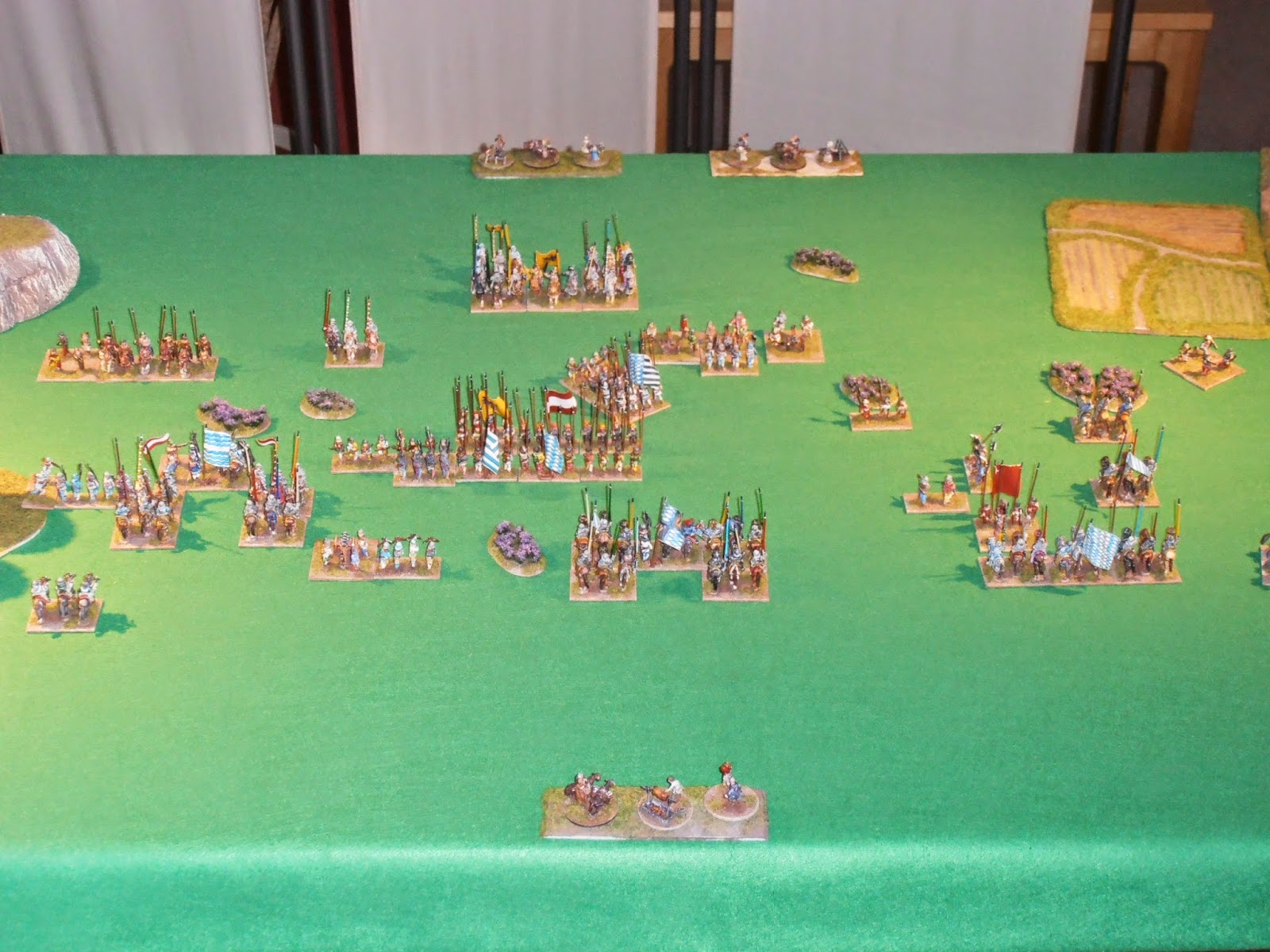
This first photo shows the initial deployment.


A brief summary.
The Austrians moved both flanks to engage the enemy while the center held back to employ better their massed guns. The Bavarians having less artillery were compelled to engage the Austrians as quickly as possible. The Bavarians may have lacked artillery, but had an advantage of crossbowmen to compensate.

The Bavarians moved slowly forward so as to be able to fire while moving. This approach delivered a number of enemy recoils but for the most part had little effect.
By bound four, the Swiss were earning their reputation making good use of their pike supported by blade. The following turn brought more losses, such that the Bavarian left wavered and became demoralised.

Second photo shows the position at the end of bound two.


Quite the opposite was happening on the Bavarian right as their knights bested the Austrians to demoralize them on the following bound.   


Time was called on what was a very close game as both sides, having lost a command each were so close toward claiming a second. We finished the evening with some interesting observations and comparisons with DBM.

The both liked the flank support option among blade, crossbow and spear. 

Only the Swiss had pikes while both Austrian and Bavarians made use of spear. 

Psiloi or skirmishers were becoming very useful and no longer the cannon fodder they used to be. 

Pursuing blade were instrumental in knocking out the Bavarian left, while the Bavarians made good use of their knights supported by solid foot on the opposite flank. 

Our next game, scheduled in two weeks, will bring us back to the ancient period with a larger game during the Marcommani wars. 

Sunday, 20 April 2014

An invasion of Bavaria. - 1399

Storm Within the Empire – DBA3 battle report.

The Duchy of Bavaria-Straubing was next on the Herzog von Steirermark’s list of acquisitions. Assembling an army, stiffened with Swiss mercenaries they marched along the Danube toward Passau. Scouts returned informing his Lordship, the Bavarians were “a-waiting his presence” north of Passau. So much for stealth.

To confront the gathering storm from Steirermark, the Grand Duke gathered loyal Bavarians from the domains of Landshut, München and Ingolstadt. 

Deployed to meet the Austrians, the Grand Duke held the centre with the majority of infantry and the reserve. To the right, Albrecht, his nephew commanded a mobile force supported with halberdier and handgunners. The left flank was held by Cousin Rudolf with a similar but smaller force.


Ahead, the Grand Duke could see clearly the Swiss on the right and to the left, a large formation of Austrian knights. The infantry in centre were numbered less than his own, but these were flanked by crossbowmen and more worrisome, cannon.

Bound one.
The Swiss yodeled their way forward and to annoy their enemy throughout their LH. Both formations of Austrians moved forward. As per plan, the Grand Duke moved his center forward with both wings held slightly back. It was hoped that weight of numbers would break the Austrian line where it met the Swiss.


Bound two.
A low die cast for the Austrians brought on a moment of hesitation. In this moment, reserve units were moved closer toward the main battle line. Unperturbed, the Swiss moved forward, while the artillery was still getting their range.
As the Austrians were less willing to move, the Bavarians brought the fight to them. Bavarian spearmen pushed their center line back, while other troops rallied to move forward and support the center. Now in range of artillery and crossbow, the Austrians were recoiling from fire storm.

Bound three.
Swiss pike and blade formations were pressing forward. The Swiss commander setting an example, lead the dance. The music, played false, the Swiss general fell sending a loud cheer among the Bavarian ranks. In the centre and right flank, the Austrians wriggled enough to deliver the first Bavarian casualties.


The Bavarians on the right seized the moment to knock about the broken formation, demoralizing the Swiss. In the centre, the Bavarians stabilized their line. On the left, losing two crossbow units, the Bavarians took advantage of the confusion to bring a unit of knight down.


Bound four
The Swiss, despite losing their general remained steadfast like a wall. At the Austrian centre, the clash of spear delivered another enemy unit, bringing the Bavarian total to 3 lost. The combat between knights on the right flank created only dust as units moved back and forth. The Bavarians on their turn were grinding the Swiss down to half the number they started with. In centre, the combat along the line delivered no results, perhaps due to fatigue, however, from the Bavarian left a loud cry was heard as their general bested the Austrian commanders. With both flanks demoralised, the Grand Duke ordered a retreat.


On a positive, the Grand Duke would save money paying less Swiss.

Epilogue
It has been a while since my Late Medieval armies have made an appearance. The practice game was actually a prelude to the same game being scheduled for later this month between two keen players.

With the exception of the Swiss, the composition of troops was identical; Kn, Cv, Bd, Cb and Sp. Although the Austrians outgunned the Bavarians in artillery, the “solid” foot helped the Bavarians. Flank support worked well and Ps handgunners did excellent work keeping the Swiss pike occupied.


Monday, 21 October 2013

Castle Building – nearing final form

Yesterday’s problem with the gatehouse is solved. The appearance dominated the rest of the structure, so some trimming was in order and secondly, the interior ground is raised and by extending that height beyond the gatehouse also helped.

From the photo you will note scraps of foam placed around the perimeter, once fixed to a base will form boulders. 


We are close to the finish line, but first some notes for myself to set a proper sequence of tasks.


The eight structures, glue them into four groups; two towers and main hall, the two pieces forming the long side another two and the gatehouse.

Undercoating, painting and detailing the stonework for all the groups.

Roofing to be put in place. These are embossed N scale sheets from Faller or Noch.

From the courtyard and extending beyond the gatehouse to be covered with a sand/white glue mix, later painted and dry brushed.

All four groupings and elevated courtyard glue together fixed to a base.

Boulders placed and shaped to form a perimeter, painted and dry-brushed.

But first:


I will leave this project here for the moment as I must make preparations for two other figure painting tasks. 

I have a Seven Year War Russian project which needs a lot of bases cut, so I will add the Castle’s base to that job. Secondly, my Sassanid reinforcements will arrive this week and I want to start planning the colour schemes for them. 

Cheers, 

Sunday, 20 October 2013

Castle Building – the interior

I have added a few items to the model. A second smaller tower now flanks the main hall. and to fill a vacant spot near the gatehouse, another block was cut and completely trimmed and scored.  


All exterior surfaces now simulate a stone surface. This would be complete if it were not for the gatehouse. There is something not right about it and I have tried arranging the pieces in different combinations. Generally a good night’s sleep will help me find a good solution.


Once the final arrangement is made I can prepare a base for the model. The model remains 3 x 3 (BW), but the base will be slightly larger to allow for boulders to give the impression of a mountain hilltop.


Looking at the arrangement there would not be too much changed to make the castle appear Italian; pitch of roof less pronounced, wall surfaces should be smooth to reflect the use of brick or plaster.


Cheers,