Sunday, 1 May 2016

Project Rome - post 2nd Punic War.

The campaign-siege rules, army lists and scenarios for the Witcher Project are complete and now start the final stage of intensive play testing all scheduled for this summer and fall. I am pleased with the development of the siege rules, however, the campaign rule set does demand the reader to have a good knowledge of events in the game series which does have its drawbacks and the integration of magic will require much experimenting. Rather than wrestle with this problem I have opted to design a solid ancient campaign system on which the fantasy-magic elements could be later added. This brings me to the topic at hand, why the selection of Rome of the post 2nd Punic War? Most importantly, this was a period when Rome developed an efficient military system which overcame the setbacks experienced during the 2nd Punic War and one that eventually overcame the variety of fighting styles of new enemies. 

Rome of the mid-republic is well known for the wars against Carthage and Macedon but after reading Livy’s History of Rome, I found the long and difficult campaigns in Iberia and Liguria would serve well for what was needed; campaigns of conquest, large and small scale conflicts, plenty of treachery, and sieges. Lastly, the project would require new figures to be collected and the construction of new terrain pieces for Hispania.   

II/33 Polybian Roman, 275 – 105 BC
Looking at the DBA 3.0 army list we have 2 x Cv, 4 x Bd, 2 x Sp, 2 x Ps and 2 x 3Ax/4Ax which are allies. Reading Livy and Polybius, Rome raised consular armies for campaigns which comprise of two legions raised from Roman citizens and two legions from the Latin provinces. I plan is to build a big battle size collection and tripling the quantities should bring the totals to a suitable size, however, I found the proportions Roman to Latin were not quite right. To solve the disproportions, I approached the elements issue from a different angle. 

The Consular Army
Each legion in the consular army is comprised of 1,200 velites, 1,200 hastati, 1,200 principes, 600 triarii and 300 cavalry, bringing a total of 4,800 infantry and 300 cavalry. Two such legions conscripted from the Roman citizenry and another two from the Latin allied provinces will bring the total force to around 20,000. In exceptional circumstances, the numbers could be increased, but the proportion of Roman to Latin would remain consistent. 

Using the historical ratio given at page 14 or the rule book, the number of elements for a consular army are now 2 x Ps, 4 x Bd, 1 x Sp and 1 x Cv per legion Romano and 2 x Ps, 4 x 3/4Ax, 1 x Sp and 3 x Cv per legion Latini bringing the total number of elements to 36 including the two consuls (Polybius gives allies thrice the number for allied cavalry). 

Reading Livy’s account of the Hispanic campaigns, it was common to split the consular army into wings (1 Romano and 1 Latini legion) with each undertaking different objectives which works well for the number of scenarios I have planned for. 

I do not expect this project to surpass the Severan work as the number of armies required to be collected will be relatively small in number. I do think the project will achieve its primary goal and that is the development of a solid campaign system.  

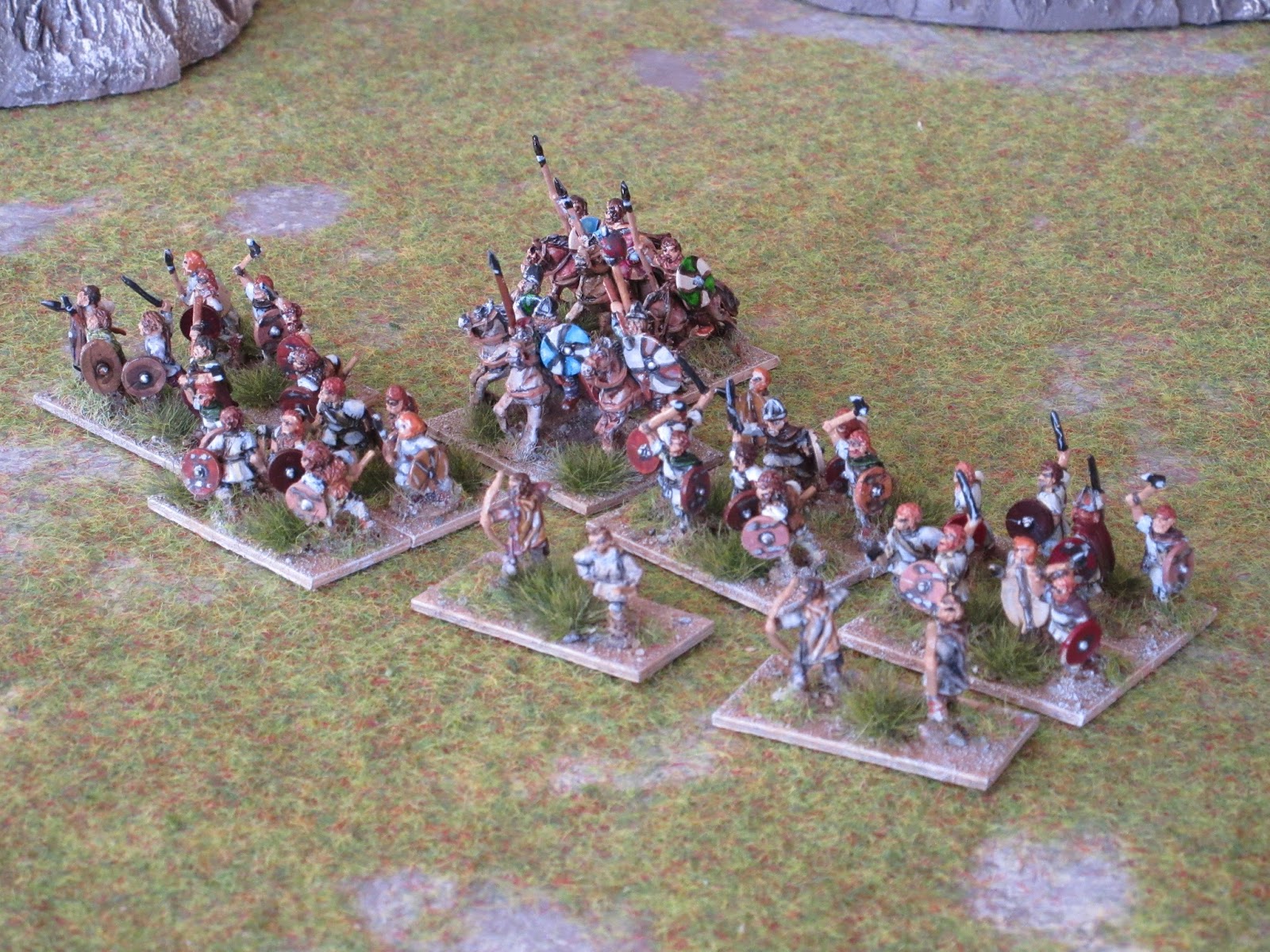
The first elements. 


Sunday, 27 March 2016

An eastern battle – 221 AD.

Inspired by Anthony Riches’ Thunder of the Gods, I fashioned a game between a similar compositions of troops but constructed as an open battle.

Two Roman commands (II/64b) would meet the King of Adiabene (II/22e) supported by a Parthian ally (II/37) led by the 22nd son of the King of Kings. The King of Adiabene as defender of his realm (Dry) set up a position between patches of rocky ground and difficult hills. The initial deployment had the Romans marching toward the foothills to meet the two armies.


Adiabene fielding more infantry than cavalry would position its force on the left to take advantage of the rough ground while Parthia, positioned on the right would have plenty of open ground to maneuver and outflank the approaching Roman force.

Having a homogeneous army, the Roman general deployed a smaller command of nine elements (Ax and Cv) to support the main effort comprised of all the legions, archers, cataphract and light horse. The main body would focus their attack on the Parthians while the smaller command would keep the snake-charmers occupied.


The Roman main body performed their task well enough despite a few turns with low pip scores. With a steady advance their archery fire frequently disrupts the Parthian battle such that any thought of a cohesive assault would not be possible. If an attack were to be launched then this would be executed piecemeal.


At the very moment Parthia did reform their battle-line Rome struck (turn 3). Roman legionnaires pushed back vassal knights leaving their King exposed. The King faced archers, but supported by blade were able to best the general bringing the score 2–0. The next unit of vassal knights recoiled for their effort and next to them the light horse were crushed by the Roman Cataphract, bringing the score 3-0. A last melee saw two more Parthian light horse succumb to encirclement by legionnaires and Roman light cavalry score 5-0 and Parthia demoralized in one bound.


Seeing the Parthian banner fall, the King of Adiabene called for a general marathon run back to the city fortress.


Reading the entrails.
Since starting the Severan Project, this was the first opportunity I had for Rome to meet Parthia and I was pleased with the results especially as the composition of the two commands took on a different form than I was used to. Generally, I like to have some legionnaires supporting each command, however, this time a small command of six auxilia support by three cavalry and the remainder of troop types grouped in the main body.

Interspersed between the blade the two archer elements could effectively deal with enemy cavalry and this mix of troop types (Bd + Bw)  flanked on either end by Cataphract created a battle-line of eight elements, a very solid looking front which Parthia could not hope to match if they made use of LH columns which they did.  


This would be interesting to follow up on this with Adiabene hiding behind its fortress walls hoping for a relief force. That relief force would contain the remnant of this Parthian force reinforced by a new Parthian army under the command of the 21st son of the King of Kings. Roman strength would remain the same.  

Saturday, 6 February 2016

The Battle of Issus - a test game.

“This should not have happened.”

As defender, the position behind the Pinarus seemed a strong one with the Sea of Issus on the left flank and the foothills of securing the right flank. One minor drawback, troops of the right flank were too far away to deploy behind the Pinarus, however the river did wind its way close to the centre command making it possible to defend the river bank on the first turn. The deployment of the left flank did not reach the sea but kept close contact with the centre command, here the seven units of cavalry would be sufficient to cover the open expanse.


Anullinus noting the small numbers on the usurper’s left deployed his central command opposite them and a near equal sized command opposite Niger. All the cavalry excepting the Contarii were grouped together forming a mobile reserve.

Seeing the buildup of strength opposite the right and centre positions, the opening moves were spent shifting troops eastward and those positioned on foothills would now redeploy behind the Pinarus. This was a bit of a race to reach the river first.

The first attempt by Anullinus to cross the Pinarus discovered its banks were steeper than thought. This posed less of a problem for the dice gods were extremely kind; crossing as individual units they still gave the impression of a huge wave moving forward.


After the game Anullinus (Jan) shared his strategy with me. Leading with the strong left flank (CinC) these would cross the Pinarus first drawing off troops from the central position. The mobile reserve would be set in where needed.

That seemed like a sound plan as some blade and auxilia were able to cross the Pinarus before an adequate defense on the right could be set up by Niger. Nonetheless, these were contained and pushed back as Jan commented later; the battle seemed more like the landing at Normandy.

Cavalry reserves from Niger’s central command were moved up to support the right and after several turns, the command of Anullinus became demoralized.


Further along the line, the central command of Niger held the Pinarus position beating back every attempt to cross. In desperation the mobile reserve (6 x Cv) sought a crossing point further downstream and found this held by one lone auxilia. These held their ground and moving a unit of cavalry to their support on the following bound killed their general (oops).

To top off the setback, Niger was able to sack the Imperial camp (oh dear).


Assessment
I shared the actual account of the battle according to Cassius Dio including the thunderstorm that the troops of Niger saw as an omen from the Gods. The more we talked about the events being set in a scenario I realized this would game would be better placed in a small campaign with a narrative.

1.     Severus with the bulk of the army besieged Byzantium, Niger’s capitol.
2.     Sealing off Byzantium from Asia Minor, Severus crossed the Sea of Marmara.
3.     Battle of Cyzicus, Niger is defeated.
4.     Battle of Nicaea, Niger is again defeated.
5.     Severus resumes the siege of Byzantium while sending Tiberius Candidus in pursuit of Niger.
6.     Niger defends the Cilician Gates.
7.     Time is now spent raising frontier troops.
8.     Egypt now supports Severus as do other cities and some military units.

9.     Leaving to consolidate his situation, Niger confronts Anullinus at Issus. 

This approach has much potential as a small campaign.

Friday, 5 February 2016

Battle of Issus 194 AD - the background.

The Battle of Issus was the third and final engagement between the forces of Septimius Severus and the usurper Pescennius Niger. In the year 193 AD, Pescennius Niger then governor of Syria claimed the title of emperor and rallied the eastern legions to support his claim.

Septimius Severus with the support of the Danube Legions entered Rome and secured his position there. Gathering a force from the Danube provinces he crossed the Dardanelles to meet Niger at Cyzicus and again at Nicaea. Twice defeated, Niger withdrew intact to the Taurus Mountains. Holding the forces of Severus at bay in the Taurus, Niger realized his situation was tenuous as support for his claim to the throne was slowly eroding; a number of cities in the east changed their loyalties, Egypt declared for Severus and the IV Ferrata deserted to the Severan camp. 

Niger departed the Taurus position to consolidate what remained of his power base at Antioch. Near Antioch, on the field were Alexander defeated Darius III, Niger met Cornelius Anullinus at Issus (May 194 AD).

The Armies
 We know that S. Severus had gathered 16 legions to campaign against Niger’s Syrian legions totaling no more than six. From Cassius Dio we learn that one legion had declared for Severus and defected during the spring of 194 and that Severus was occupied with the siege of Byzantium.

For our test game, we have given the Middle Imperial Romans of Anullinus three standard commands and modified those of Niger’s army by reducing number of blade and filling the difference with auxilia and mounted troops. The final composition of forces is listed below.   

Commander Cornelius Anullinus
9 x Cv, 3 x LH, 12 x Bd, 12 x Aux.  

Commander Pescennius Niger
7 x Cv, 5 x LH, 9 x Bd, 15 x Aux.

The Battlefield.
The coordinates of the battlefield given at Wiki show a relatively flat area within the modern city of Dörtyol. An outnumbered Niger may well have remembered Alexander’s victory at Issus and sought a similar position behind the Pinarus River. In such a position his left flank would rest on the Gulf of Issus while the right flank could make use of the higher ground against the troops of Anullinus. 


See Livius.org for photos of the battle area. 

The terrain set up will mirror the battlefield of 333 BC. Niger's position is south of the Pinarus River with Anullinus deploying on the opposite bank.


Frank Martini. Cartographer, Department of History, United States Military Academy - Ancient Warfare Atlas Index at The Department of History, United States 

Wednesday, 3 February 2016

The Tervingi

The Tervingi are mentioned in Phil Barker’s Armies and Enemies of Rome book as a Gothic people living west of the Dniester River and having close ties with the Greutungi; both of which are listed in DBA 3.0 as II/65 and II/67 respectively. The Tervingi are for the most part warriors who fought on foot in dense masses with a small number of mounted nobles.

The Hunnic invasions of the third and fourth century AD, forced the Tervingi moved to the Danube basin along with other tribes fleeing the eastern menace. These two Tervingi commands are a mix of Old Glory Visigoths, German and Dacian infantry as are the mounted figures. They are described as wearing fawn coloured clothing with a trimmed hem but not cuffs and their shields are covered with simple designs or plain leather.

Draco standards made from Milliput will be added later to the command stands and smaller versions to one or two infantry elements.   

II/65 Tervingi
1 x General (Cv), 1 x Cavalry (Cv), 8 x Warriors (4Wb), 2 x archers (Ps).

Tervingi 1


Tervingi 2


The Tervingi make interesting opponents as their time period overlap the Middle and Late Imperial Rome periods. For big battle conflicts, the Tervingi use as allies the Carpi (Dacia), for which I have three commands to select from and the Greutungi which are half mounted (3Kn) and half archers (Ps). These will make an interesting army when I return to this project.  


Cheers, 

Monday, 4 January 2016

Meroitic Kush and the Noba.

Here are photos of the recently completed Meroitic Kush and a rival claimant of the Noba tribes; the latter follows the Nobades army of II/55a. Troops are identical and the two blade are exchanged for two auxilia and one spear element has been replaced by an extra skirmisher. The two will make interesting opponents as both come from differing geographical areas; steppe and dry. Scenarios can now be written for civil conflicts or the two can be grouped to form an invasion force of Upper Egypt.  


Command standards were the last items constructed and from my initial research such symbols may have simulated the Egyptian military standards of an earlier age. I would think with the passage of time any references to ancient symbols would have become stylized. Looking at jewelry, figurines and bas-reliefs held at several museums I selected two styles might best represent standards for the two commands; the fan shaped emblem and the sun disk. The ribbons underneath the emblems are painted in the same theme colour as the army.


Because the two armies may be used together I chose to duplicate the shield patterns but use different colours as accents. The later Nobades after 200 AD (b sub-list) increase the number of mounted elements and introduce camel warriors. For these troop types I have selected the Blue Moon camel mounted Fuzzy Wuzzy as these will have similar hair styles. These will be placed on order soon.

II/55a Nobades 30 BC – 200 AD
1 x General (Cv), 1 x Cavalry (Cv), 2 x Cavalry (Cv) or spearmen (3Ax), 4 x archers (3Bw or Ps), 4 x spearmen (Sp or 3Ax). Terrain type: Dry, Aggression 2

II/55b Nobades 201- 831 AD
1 x General (Cv), 2 x Cavalry (Cv), 1 x Camel rider (LCm), 2 x Spearmen on camels (Cm) or on foot (Sp), 2 x Spearmen (Sp), 4 x Archers (3Bw or Ps). Terrain type: Dry, Aggression 2

Thursday, 24 December 2015

Meroitic Kush – the miniatures.

The ten infantry elements are nearly complete but I thought I would place an update on the Kushite activity with a sample photo and brief text.

I am pleased with the range of clothing colour which disguises the fact that these are later period Sudanese. The muted green, blue and beige clothing are bleached to give a sense of long exposure in the sun and the skin tones and highlights have a natural sun baked appearance.

Figures were all rebased to group necessary sword armed types into two blade elements and the remainder now forms five elements of spear.

The three bow armed elements are Amorite taken from an Old Glory Biblical range. Their beards have been cut away and their clothing follows the standard fashion, however these do demonstrate their preference for another hair style.

The cavalry are Classical Indian types and with an application of Milliput now have a similar hair style as their brethren and round shields which replace the oddly shaped ones they carried before. The “Chief” has a crown similar to the illustration of King Silko done by Angus McBride and now sports a cloak.


The Milliput should be thoroughly cured tomorrow that I can finish the cavalry elements. One more day for groundwork and grass, these should be ready for their final photo this weekend. And this is just in time as a delivery arrived yesterday with figures for my latest project.